

'The Reason Gen Z Isn't Dating' - What The NYT Missed
A generational crisis described, but not understood

The New York Times weighed in on why Gen Z isn’t dating. The author, Christine Emba, is in her late 30’s and leans conservative.
She catalogues Gen Z’s dating challenges well, but stops short of inquiring about the psychological and cultural conditions that produced them. I found it to be surface-level and uncurious.
She connects the gender propaganda they consume online to resenting, and being afraid of, the opposite sex. But she doesn’t ask how an entire generation’s sexuality, which is inextricable from one’s identity, became confusing and foreign to them.
In this post I summarize the article then explain what’s missing.
Article Highlights
Here’s a brief summary of the article in case you don’t feel like getting past The New York Times’ paywall.
I think my paywall comes with a bit more substance, no? :)
She begins by stating looksmaxxers are just incels who define themselves by their appearance rather than their lack of sexual partners.
References Clavicular’s justification for why he doesn’t have sex.
In one filmed rant, Clavicular described his life as “hell” but said he had to looksmaxx in order to “deal with the burden that women in today’s hypergamous dating market” had put on him. More recently, he confessed to The Times that knowing he could have sex with a woman was perhaps better than the deed itself. “It’s a big time saver,” he said.”
Points out the economic and cultural issues Gen Z has faced:
Watching porn too early
COVID putting major limitations on their formative years
The confusing world of dating apps
Poor economic outlook
Less opportunities to achieve higher status
Courtship norms broken down
Says the highly-viral gender content creates new categories to judge people on, such as the amount of people women have slept with and men not giving women too much attention.
Notes how Gen Z’s problems manifest in both sexes.
Men: Looksmaxxing and childish misogyny
Women: Embracing yearning and romanticizing solo living
Tells a story about a group of Gen Z men who spent their summer posting about the female archetypes they hate.
Cites a few studies about Gen Z: only 30% are actually dating, only 40% find themselves to be attractive enough to potential partners, only 25% feel confident enough to approach the opposite sex or stay positive after a rejection or breakup.
Ends the article with a good summary.
For younger adults, romance has turned into something to be debated, theorized and optimized for but not actually engaged in. As Gen Z retreats into itself while pretending to focus on the other, the delta between the sexes grows wider.
What’s Missing
The author does a good job of describing the reality of the situation and many of the variables that contribute to it. However, she doesn’t probe into the root causes.
Here’s what I would have included:
Looksmaxxing
It’s important to keep in mind while reading Clavicular’s anti-sex justifications that he’s admitted to being impotent and therefore can’t maintain an erection.
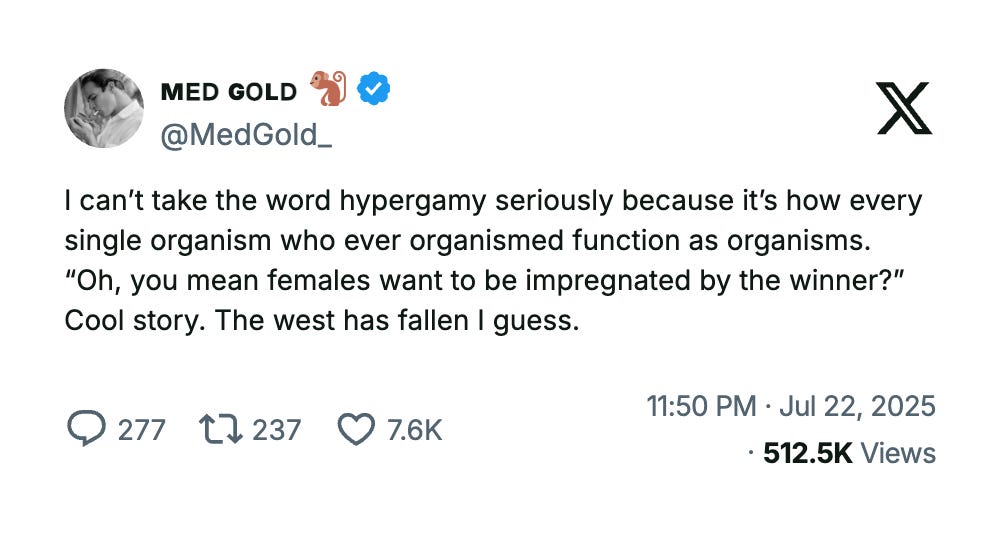
Clavicular’s emphasis on female sexual selection reads differently when you take his admitted sexual dysfunction into consideration. Unfortunately, young men are getting advice from a man who can’t get an erection and smashes his face with a hammer to appear more attractive. But he isn’t trying to look attractive to women. He’s trying to impress random men on the internet. I’m inclined to think his advice isn’t exactly useful.
If a man is physically incapable of having sex, then his opinions on sex should be discounted. Clavicular is one of many internet personalities giving Gen Z men uninformed advice.
The Porn Problem and Vibrator Dependence
Porn was mentioned very briefly:
For many, online porn was an early introduction to sex, setting emotional detachment and gender antagonism as a standard.
The problem goes far deeper than that. If porn is a young man’s primary education in sex, then his sexuality will mostly be shaped through voyeurism and passivity. This is a toxic replacement for the knowledge obtained through real intimacy with actual women.
Also, watching porn is likely making Gen Z men feel defeated. Watching other men have sex with women they’d like to have sex with is bound to have negative psychological effects. I’m convinced watching other men sexually outshine them on a regular basis is a contributing factor in why they don’t feel confident enough to approach women in person. Porn is an unnecessary factor that further warps their understanding of male-female dynamics.
A separate but related issue — I would have also mentioned many Gen Z women’s reliance on sex toys. Habitual masturbation, especially with toys that are extremely stimulative, can stifle their sexual responses during sex and make pleasure from a man feel muted in comparison. Sex toys do not replace the sense of validation a woman feels while being penetrated by a man they’re genuinely attracted to.
Dissatisfaction through lack of feeling lusted over doesn’t just disappoint a woman, it gets rerouted as rage through a deep sense of rejection from men. Often, her attention moves away from attracting men and towards things outside of her control.
Men and women withdraw from each other when they feel sexually unsatisfied. Porn and vibrators significantly contribute to this problem.
“Red Pill” Content
A significant number of young men have indeed been brainwashed by “red pill” content. The men producing this content are less anti-feminist than they think they are. Raised in the 2000’s, they absorbed feminist assumptions about gender equality.
In their minds, given men and women are the same, women should be held to the same standards as men. When they notice some standards only apply to men, they produce rants about how women should be “held accountable” for their behavior.
Rather than come to terms with male-female polarity, they seem to want a girlfriend who pegs them, pays the rent, and still acts “traditional.”
Sadly, this demoralization propaganda, often peddled by disgruntled millennials who are either divorced or hung up over an ex, reinforces the belief in young men that “life should be fair, but it isn’t, because of women.” This isn’t fair to them and creates unnecessary resentment.
If men don’t have encouraging advice to offer, they shouldn’t give any at all.
Lack of Male Autonomy
The author, correctly, mostly focused on what’s affecting Gen Z men more than Gen Z women. The majority of female behavior is a response to male behavior and their preferences.
Gen Z men have been made to feel powerless, whether through porn or gender war content that’s often viral in their feeds. Feeling incapable of attracting a woman, they become detached commentators rather than active participants in the dating world. As a result, a surprising number of ostensibly heterosexual men have become more psychologically oriented around male approval rather than female intimacy.
Young men seem to misunderstand how seriously women care about what they think. They feel far too depressed, mostly by what they consume online, to understand how much power they actually have over women. If more Gen Z men recover a sense of agency, Gen Z women will likely respond to that shift.
Related Posts


I would also add: "maxxing" as a form of competition and prestige.
If you dumb down female attraction to a game of height, physique, looks, penis size, money, it gives people meaning and something concrete to chase. Although those factors matters to some extent, collectively it's insignificant in human connection and sharing a life with someone else. But nevertheless, for those who grew up online, it has become like Plato's Allegory of a Cave which if that understanding of female attraction is all they've been exposed to for their lives, then that is their model of how the world works.
Another interesting note is someone mentioned the other day how AI progress fuels looksmaxxing. AI taken up a lot of our work and meaning, but what can't it do? AI can't mog.
Great piece!