

Why No-Fault Divorce Is A Good Thing
Less mediocre relationships means less mediocre people

There’s countless theories on why people have less children. I stated my position on the topic three years ago in The Dark Path to Increasing The Birth Rate, which hasn’t changed. The problem isn’t that people have kids less, it’s that no one is having sex. People are less passionate. The Fuck Rate is abysmal.
Marriage, however, is a much more complicated matter. Some people like to romanticize the high Marriage Rate of the past. The problem with romanticizing things is being ignorant to, or intentionally ignoring, Reality.
Just because people are married doesn’t mean they’re happily married. Just because people had children doesn’t mean they should have had children.
If the institution of Marriage was invincible, it would have been able to withstand the introduction of No-Fault Divorce laws. Well, it didn’t. It got obliterated. If giving people the choice to exit a contract kills the entire institution, then that institution is weak.
This reveals less about the institution of itself and more about why people choose the people they do.
The Marriage Rate decreased by 13% from 2008 - 2022, per 1,000 people:
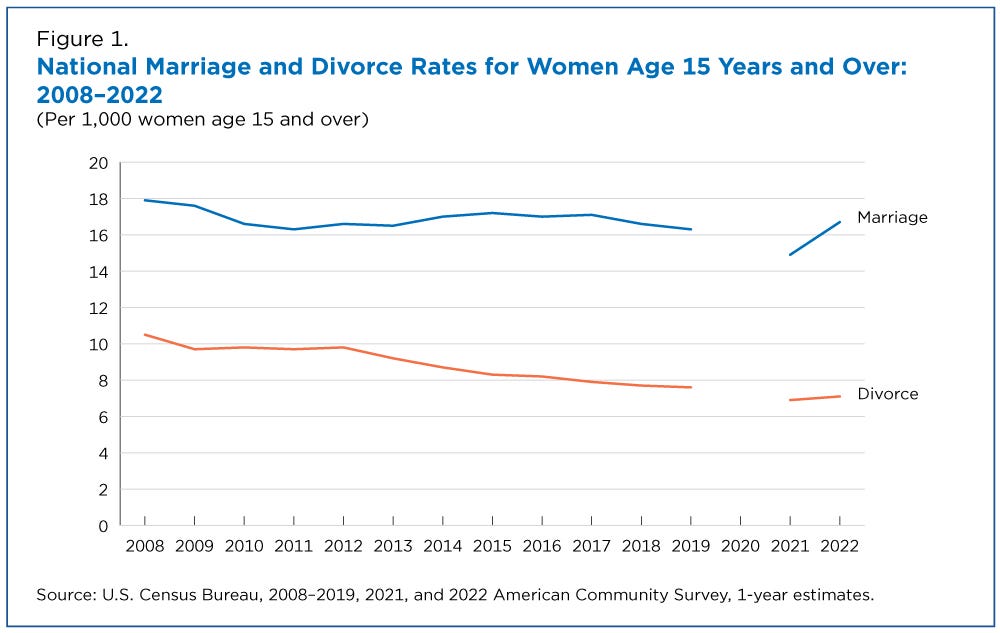
However — the Divorce Rate decreased by 31%. That’s fantastic news.
Surprising, isn’t it? Why is this the case?
Let’s compare the current marriage and divorce rates to 1950, an era some people like to romanticize.
Marriage
1950: 11.1 | 2022: 6.2
Divorce
1950: 2.6 | 2022: 2.4
From 1950 to 2022, marriages decreased by 44%.
However, divorces also decreased, by 8%.
The Marriage Rate plummeted, but the Divorce Rate is lower than 1950 levels.
Therefore, the problem isn’t that people get divorced too often, it’s that people get married less often.
But this doesn’t mean divorce was never a problem.
Let’s look at the Divorce Rate over time.
Per 1,000 people:
1950: 2.6
1960: 2.2
1970: 3.5
1980: 5.3
1990: 4.7
2000: 3.5
2010: 3.6
2022: 2.4
The Divorce Rate started to rise in the 70’s, peaked in the 80’s, declined in the 90’s, and is now at the lowest level since 1950.
California introduced No-Fault Divorce laws in 1969. That explains the significant rise in divorces during the 70’s & 80’s.
The average age of a Divorcee in 1980, when divorces were at their highest levels, was 31. They’re the people we call Boomers.
Now let’s look at the Marriage Rate over time.
Per 1,000 people:
1950: 11.1
1960: 8.5
1970: 10.6
1980: 10.6
1990: 9.8
2000: 8.2
2010: 6.8
2022: 6.2
The Marriage Rate increased in the 70’s & 80’s, declined in the 2000’s & 2010’s, and is now at the lowest level in recorded history.
For the sake of argument — let’s use 31 year olds, the average age of the divorced Boomer in the 80’s, as the point of reference.
Let’s also think about the children of divorced parents.
The Marriage Rate significantly decreased in the 2000’s & 2010’s. People who were 31 during those years are Gen Xers.
Gen Xers are the children of Boomers.
Given the Divorce Rate of Boomers, Gen Xers grew up in broken homes at the highest rates ever recorded.
Gen Xers got married significantly less often than Boomers, but also they got divorced less often than Boomers.
Therefore, we can conclude that Gen Xers were more blackpilled about marriage than Boomers but were more intentional about who they married than Boomers.
The Marriage Rate was the lowest ever recorded in 2022. People who were 31 in 2022 are Millennials.
Millennials are the children of Gen Xers.
Millennials are getting married less often than Gen Xers, but are also getting divorced less often than Gen Xers.
Therefore, we can conclude that Millennials witnessed less Gen X marriages than Gen Xers witnessed Boomer marriages, but are more intentional about who they marry than both Gen Xers and Boomers.
The trend is clear — with each generation, people are getting married less often, but are more intentional about who they marry.
Boomer Derangement Syndrome and No-Fault Divorce Laws
Many Millennials have a severe case of BDS (Boomer Derangement Syndrome). They blame Boomers for everything. If you even mention Boomers around them, they get triggered and become histrionic, like the touchy snowflakes Boomers see them as.
This is mostly an economic problem. Boomers were born into the most economically prosperous era of America. Therefore, they own most of the real estate, and got rich without needing to try.
The Millennial-to-Boomer hate is understandable, but it’s a bit much.
Anyway, I’m not going to blame the plummeting Marriage Rates on the Boomers.
I’m not going to blame them on No-Fault Divorce laws either.
No-Fault Divorce is good. This is America. If you can have the freedom to speak and to own a firearm, you should also have the freedom to leave a relationship.
Imagine needing to go to the local Department of Relationships Office to have your Divorce Request reviewed by the same mouth-breathers who work at the DMV? Sounds fucking terrible.
And it’s none of their business. Your relationship isn’t the business of your State, the US government, or anyone else. It’s between you and your spouse.
It shouldn’t be easy to exit a marriage either. Marriage is an institution designed to promote the creation and sustainability of families. Divorces destroy childhoods.
Depending on the state you live in, it isn’t easy to exit a marriage, and it’s often quite expensive depending on the net worth of the couple in question, and whether or not they have children.
Marriage isn’t a perfect institution, nor is it invincible.
Let’s take a look at the Boomers a bit more closely.
Baby Boomers are, by definition, the children of Silent Generation fathers who fucked their wives like rabbits after coming home from WWII. The Birth Rate in America skyrocketed. There were a lot of people to marry.
You don’t hear about couples who are absolutely crazy about their spouses getting divorced, do you? You haven’t. That’s because it doesn’t happen.
Boomers didn’t get divorced simply because they could. They weren’t just being dicks who wanted to fuck over the future.
Boomers got divorced because they wanted to, but they couldn’t, and No-Fault Divorce laws allowed them to.
If Boomers were happy in their marriages, they wouldn’t have gotten divorced.
Yes, it really is that simple.
Is Marriage an Inherently Strong Institution?
The above data proves — no, the institution of marriage isn’t built to withstand having the freedom to leave it. In turns out there merely having a wedding ceremony, signing documents, then entering a lower income bracket, doesn’t guarantee that your relationship will stand the test of time.
No-Fault Divorce laws tested the strength of the marriage institution. If something is strong, it should be able to withstand all challenges to it.
Does that mean I think we should just get rid of the institution of marriage? No. Marriages indeed do keep many people together. The act of promising your commitment to someone in front of everyone you love, and God (depending on the type of wedding) — changes the dynamic of a relationship, increases the stakes, and often does keep people together, especially if they have children. But marriage clearly isn’t the only thing that keeps people together.
The fact that Marriage as an institution couldn’t withstand No-Fault Divorce laws isn’t an affront on Marriage itself.
It’s an affront on why people stayed together when they didn’t want to. There was tremendous cultural pressure to not get divorced. Divorce was considered taboo. Many people think this is a good thing.
Well, that didn’t work.
There’s still a lot of value in marriage, but pressuring people to stay together when they don’t want to — is cooked. Those days are over. And that’s a good thing.
Children who are raised by parents who hate each other either grow up to become basket cases, or live their lives with a terrible model of what Love looks like. They repeat the same process their parents did. The cycle of breeding People With Issues continues.
I prefer a population of fewer people raised by parents who are crazy about each other than a large population of people raised by parents who hate each other or settled for a relationship that only was a 6 out of 10.
New Cultural Pressure: Break Up With People Faster
What does this say about relationships in general?
It simply means that true love is extremely rare.
This isn’t news.
But it’s a great reminder for people who think you should just get married for the sake of it or stay together when two people have tried their hardest.
Very few people are supposed to be together.
Too many people stay together when they shouldn’t.
Only the truest of friends will tell you “just break up with them.” True friends are rare.
People are more likely to root for a bad relationship to rise from the ashes and succeed. But that happens less often than we want to admit.
It’s much better to detect when a relationship isn’t working, do everything you possibly can to save it, face the harsh truth when it doesn’t, then break up with them.
This is harder said than done. Willingly breaking the heart of someone you love is devastating. Facing this truth in itself causes heartbreak on its own. Being single again is scary. These are the main reasons people stay together when they shouldn’t.
And yet, the world we live in increases the chances of people finding someone they’re meant to be with. It’s never been easier to find true love. The modern world is ripe for it. The problem is that very few souls have the eyes to see it, or the courage to pursue it.
Practical Marriage is Out, True Love Marriage is In
People got married and had a ton of kids for practical reasons in the past. They needed children as future workers on the farm. We don’t live in those times anymore. We live in a very prosperous world.
You can choose who you want to be with now and plan your lives together.
That isn’t easy to do. Figuring out who you are, who you want to be with, and what your deal-breakers are isn’t easy, and it takes a very long time.
Too many people rush into things without thinking it through.
People stay in shitty relationships all the time. They want it to work, but they have a hard time facing the reality that it isn’t meant to be, or are too scared to become single again, so they try to make it work, and it fails, then they repeat the cycle. Time is charitable to no one. Their options decrease.
Fate Touches Those With The Courage to Face The Unknown
I’m certainly not a fan of situationships, which just means one of you is fucking someone but not committing because you know they’re not The One but some sex is better than no sex.
It’s wrong to be in a relationship with someone for years and never propose to them. It’s particularly cruel for men to do this to women, given Time is more precious to them.
I’m also not a fan of people staying single because they’re ignorant of the fact their options are going to dwindle as they get older. This applies to both men and women.
But the idea you should get married early, or marry the first person you fall in love with, is insane.
Give it time. Stress test it. See if you can stand living with them. If you don’t want to move in with them. Go on vacation a few times, for at least 2 weeks at a time. Learn how the other person fights. Understand what the root problems are. There’s a lot to learn about people.
If it doesn’t work, it doesn’t work. The sooner you can be realistic about that, the better. The longer you wait to admit it, the harder it will be to end it.
You might have thought they were The One. You might have thought it was supposed to last forever. The thought of dating someone else, or the thought of using dating apps, sounds horrific.
I have an opposite take on this. Dating apps are great. They give you access to more potential people to date. You have access to the biggest bar in the world and the power to kick out the people you’re not attracted to. DMs are interviews. You can filter out who may or may not be a great fit based on texting vibes alone.
We have the internet now. You’re more likely to meet someone who’s right for you on social media than you are at your local bar. This is simply a matter of numbers. You have more options than ever.
But this process is scary. Getting to know people is scary. Putting yourself in a vulnerable situation is scary.
As I’ve said before, Fate only graces those with the courage to walk into the unknown. Having the courage to put yourself out there, to make yourself vulnerable again, can indeed be petrifying. But if you have the self-awareness of where you’ve went wrong in the past, you’ll be smarter this time around. If you’re humble enough to admit your faults, and work on them, you’ll be more attractive to people the next time around.
The conditions have never been greater to find true love. It’s a matter of if you believe in yourself enough to find it.


I think you're right about the pressure being on "getting married early" and "marrying the first person you love." It works less than a lot of idealist trads would ever admit. It's mostly a LARP.
I've had people ask me what age I want to get married, and quite frankly, I think it's kind of a ridiculous question. People talk about "the age they're going to get married" all the time. I just don't get it. Seems like a sure way to talk yourself into committing to marriage for the wrong reasons.
I typically tell people that for me, anyway, it's about finding the right person first. I'm not on a set timeline. I don't care if I'm 25, 35, or 45 when it happens. I put myself out there, I talk to girls, I date quite a lot compared to most people my age, and I make an effort to connect with girls I think there could be something more with, but it's not out of desperation or panic about my age, it's because I enjoy it and I believe it will help me get closer to finding someone truly right for me in the long-term.
Where most people start to think I'm crazy, though, is when I tell them that if I'm not confident someone truly is that person, then I'm perfectly okay with going through life unmarried. I would like to get married, and I have faith that I will find that person, like you said, through fate and facing the unknown. But if I don't? That's okay. Because I would also probably rather die than make a life commitment to someone I'm not sure is the one, out of convenience or because "time is running out." I would never bring children into this world with someone unless I was absolutely confident that they would have nothing short of parents who were truly in love. I've seen what loveless or lackluster marriages do to kids. Not good. Marriage might be the last thing in life you want to "settle" on.
But, maybe that's just me. Lots of people I explain this to don't get it. Anyway, that's my two cents ramble. Great article.
Zooming out, I think the 2 biggest bottlenecks for long-term relationships (which ultimately are the core of marriages) can be boiled down to:
1) knowledge (which this substack provides)
2) economics (money is required to upgrade your situationship/initially-passionate fling into something serious)
Unsurprisingly, these 2 parts of the equation are the most suppressed at the moment, 1 with most men being gay now, and 2 due to the fact that the boomer wealth golden age was a unique one-time event that has since passed.