


We all know that one friend who’s still the same guy from high school. He tells the same stories, wears the same clothes, and never left your hometown. He never changed. He’s the same guy.
You never have to worry about that guy. You know what he’s doing next week. You know what he’ll be doing in 6 months.
But you’ve wondered if there’s more to that guy.
“Who could he be if he really tried? Is there more underneath the surface? ”
He asks himself the same thing.
Sometimes while he’s getting ready for work, he fantasizes about a better version of himself: a gorgeous girlfriend, financial freedom, and a stunning home. He’s on top of the world.
Then something pulses beneath his skin — uncomfortable and insistent. He quickly shrugs it off.
“It’s too late.” He compares himself to the homeless. “At least I have a roof over my head.” Worrying he might miss the train, he tells himself, “some people have nothing.” He leaves for work and convinces himself that his life is fine.
Which it is.
He asks himself a petrifying question. The distance between who he is and who he could be feels impossibly vast. What it would take to get there would change everything. People would say “he’s changed.” He’d no longer be the same guy from high school.
You can’t shed dead skin if there isn’t skin to be shed.
For the rest of this post, I’ll be speaking from experience.
The Epistemology of Potential
You can’t know someone else’s potential.
You can suspect someone hasn’t reached their full potential, but you can’t know if that’s true, or what that full potential looks like.
This can only be known by them.
This form of knowledge is called Privileged Access.
The visions of the guy from high school come from untapped versions of himself.
Only he knows the vision and its details.
In his bones, he knows a better version of him is attainable.
The vision is proof that version of him exists in his subconscious.
But that doesn’t mean he will unearth it.
Until he tries, he’s living inside a husk.
Uncomfortable Change
Metamorphosis isn’t supposed to be fun.
After dead skin is shed, your new skin will be raw.
You’ll feel exposed, naked, and unsure of yourself.
You’ll feel like you made a mistake.
After you escape the first layer, you can’t put it back on.
The First Shedding Process
Permanent transformation requires intense internal isolation.
You give yourself permission to ruffle feathers — especially your own.
The first evolution is radical.
People will think you’ve gone crazy.
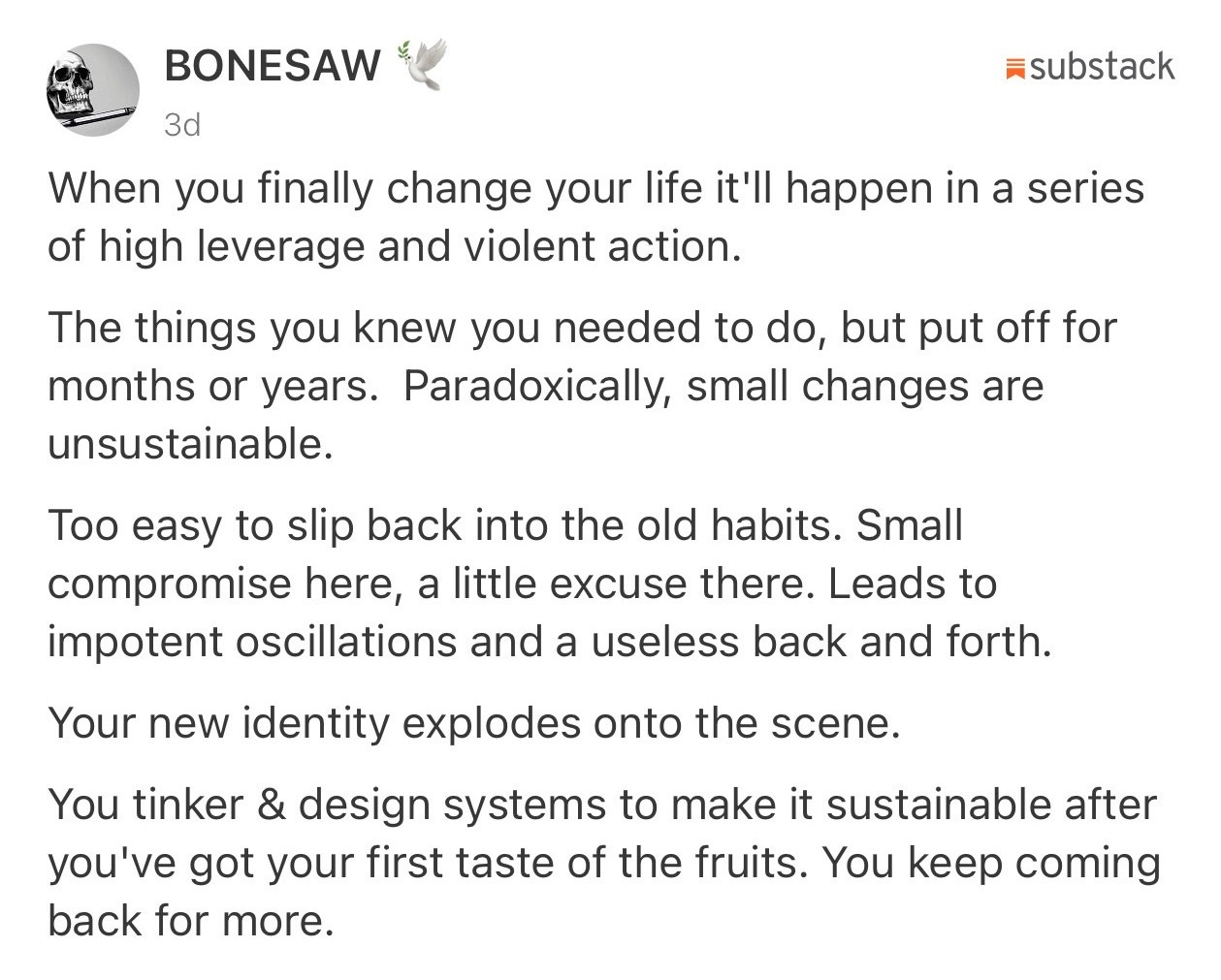
You will finally do the things you’ve avoided. Only you know what they are.
Often, that means cutting people out entirely.
Hostile Actors
When you’re determined to evolve, most people won’t like it.
They’re not used to this version of you.
They’ll claim they want “the old you” back.
But this isn’t coming from a place of concern, it’s coming from envy.
Your courage reminds them of their cowardice and stagnation.
You’ll refuse to tolerate the misalignment.
You’ll either cut them out entirely or keep them distant.
By setting boundaries, you’re giving yourself the space to expand.
Future Shedding
Few who shed once never shed again.
After the first transformation, future sheddings are less radical.
They arise less from intense visions, more from quiet equilibrium.
New skin will always feel scary, but less each time.
You’ve survived this before.
You know the other side is better, even if it’s unclear yet.
Those who stuck around will trust the process. They won’t worry.
And neither will you.
The High Risk of Change
True change is radical and permanent.
Some want it but stop at superficial tweaks.
Others overhaul their external world while the internal stays unchanged.
New phases. New diets. New religions. Endless obsessions.
They never commit. They flake on plans. They owe money.
They’re chaos.
Real change demands unwavering commitment to a future self you’re enamored with.
Nothing stops you from becoming it.
Very few have the stomach.


One of your best posts.
Banger