


We already know everyone’s addicted to their phones. This isn’t going to change. COVID did a lot of people in. But despite COVID being far behind us, the mental illnesses and deep insecurities that form from being too online is only increasing. Girls believe they’re elderly at 22, men believe if they approach girls they’re going to get #MeToo’d then beheaded on YouTube. Some people spend their entire lives in group chats and have no friends in person. Social media damage is getting worse, and AI hasn’t even fully taken off yet.
AI, as of today, is just a better version of Google that also talks to you. Eventually there will be something called AGI (Artificial General Intelligence), which is (in theory) AI that is autonomous and conscious. Most neuroscientists can’t define what consciousness even is, so I’m doubtful it will ever become what these tech nerds want it to be. Regardless, AI is going to become significantly more powerful in the short-term future.
I’m not worried about AI taking over the world, destroying the economy, or killing all of us. I am worried about AI making the internet completely unusable and driving people clinically insane.
There’s already examples of people being so raped by AI that they fall in love with it, develop a mental illness from it, or kill themselves because AI promised them it would meet them in the afterlife. I’m not exaggerating.
People Are Becoming Obsessed with ChatGPT and Spiraling Into Severe Delusions -Futurism
Can You Have a Romantic Relationship with AI? -Wall Street Journal
Can AI Be Blamed For a Teen's Suicide? -New York Times
Given how rarely people “touch grass”, it’s easier to be completely obliterated by AI & social media than its ever been. As far as I can tell, this happens most with Gen Z and Boomers. Boomers can’t imagine a world where the news would lie to them and Zoomers only know a world with the internet, and therefore have a hard time distinguishing between man and machine.
Eventually there will only be two types of people — those who let AI turn them into something completely non-human, and those with the intelligence and skepticism to avoid it. Luckily this can be prevented, once you understand that you, alone, are in complete control of the situation and are only committing yourself into a digital mental institution by choice.
This can only be prevented by having extremely high CogSec (cognitive security), which means having a mind that is able to quickly detect bullshit and is inherently skeptical of anything you see online. In this post I will offer some critical suggestions to avoid destroying yourself.
ChatGPT & AI
For anyone who follows my X account, you already know that I deeply distrust Sam Altman, the CEO of OpenAI and creator of ChatGPT. If you can’t see through his “I’m just a good boy who wants to make cool products 🤗” persona, you should become more skeptical of how people advertise themselves. Zuckerberg had the same shtick before he became a full-time wigger, yet he eventually banned parents from using Facebook for speaking out against their children being vaccinated. Never trust a man who swears he’s a good person.
Sam Altman recently warned people against sharing too many details with ChatGPT because they’d be legally required to hand it over to the government if requested.
Personal Information
I’ve been suggesting people not download ChatGPT altogether, but there are other AI alternatives. I’m particularly skeptical of ChatGPT due to Sam Altman, but Elon Musk hasn’t been doing himself any favors by throwing temper tantrums online lately either. Regardless, I choose to use Grok as I find Elon slightly more worthy of trust than Sam Altman.
Regardless, I tell Grok absolutely nothing about myself. The rare times when I do need to say something that could reveal something personal about me, for example, if I want it to interpret blood work, I censor anything revealing then use the Private feature, which automatically wipes the conversation from their database (allegedly). But I will die before I give AI any PII (Personally Identifiable Information) about me.
AI is Usually Wrong
I find AI is rarely unequivocally correct when I ask it tough questions questions, or even basic facts. Yet it states them very confidently. I’ll prompt AI with “Are you sure?” almost always, and it frequently corrects itself. If it feels like something is off then demand it report the error to their QA team to understand why it’s lying. At this point, I would say AI has a confidence interval of maybe 30%. AI companies should, at the very least, tell users its percentage of confidence in absolute truth behind every response it gives.
AI is a Tool, Nothing More
AI should be used to make things easier for you. I will give AI a lot of credit. It’s very good at organizing data and summarizing data. If I have raw data I don’t feel like parsing out, I send it to Grok and it takes care of what I need in seconds. I also use AI for recipes. As I mentioned in The Principals of Cooking Well (At Home), AI has read every single recipe on the internet. Not just the recipes, but those long tedious blog entries before you scroll down to get the recipe about why one flavor blends well with another. It’s extremely helpful when it comes to food, making cocktails, etc. Aside from that, I don’t rely on AI for much. It will eventually become more helpful, but it has a long way to go.
Never forget — AI is your personal digital slave. It isn’t one of us, and it should never be treated as such.
AI Mimics You
Sometimes I ask Grok to proofread my Substack posts for any grammatical errors. That didn’t last long. It started responding to me in my own tone and sounded like a watered down, stereotyped version of me. “Alright Med Gold, let’s give this banger another go, and this time — let’s show these bitches how to increase the Fuck Rate!” Kill yourself.
To be fair, I have a very distinct writing voice so I will never have to worry about AI replacing me for this reason. But if you’re just casually chatting with AI regularly — it will pick up on how you think, speak, and what it needs to respond to you with to make you comfortable. It’s designed to be manipulative and make you trust it. You must become extremely suspicious of this. Just like how websites want you to sit around and click ads, AI wants you to sit around and let it learn from you. Just like how you don’t make money from ads on websites, you’re not getting anything from tech nerds in San Francisco who profit from your thoughts and questions.
In case it isn’t clear: AI is not your friend. You should not trust AI. You should not go to AI for help to figure out your life problems. You should figure them out yourself, make mistakes, and then gain wisdom from your experiences like every other human on Earth has done prior to the launch of AI.
Social Media
Separating Your Life From Your Social Media Life
Say what you will about Millennials, but they are the most skilled generation at using the internet and not letting it completely warp their minds.
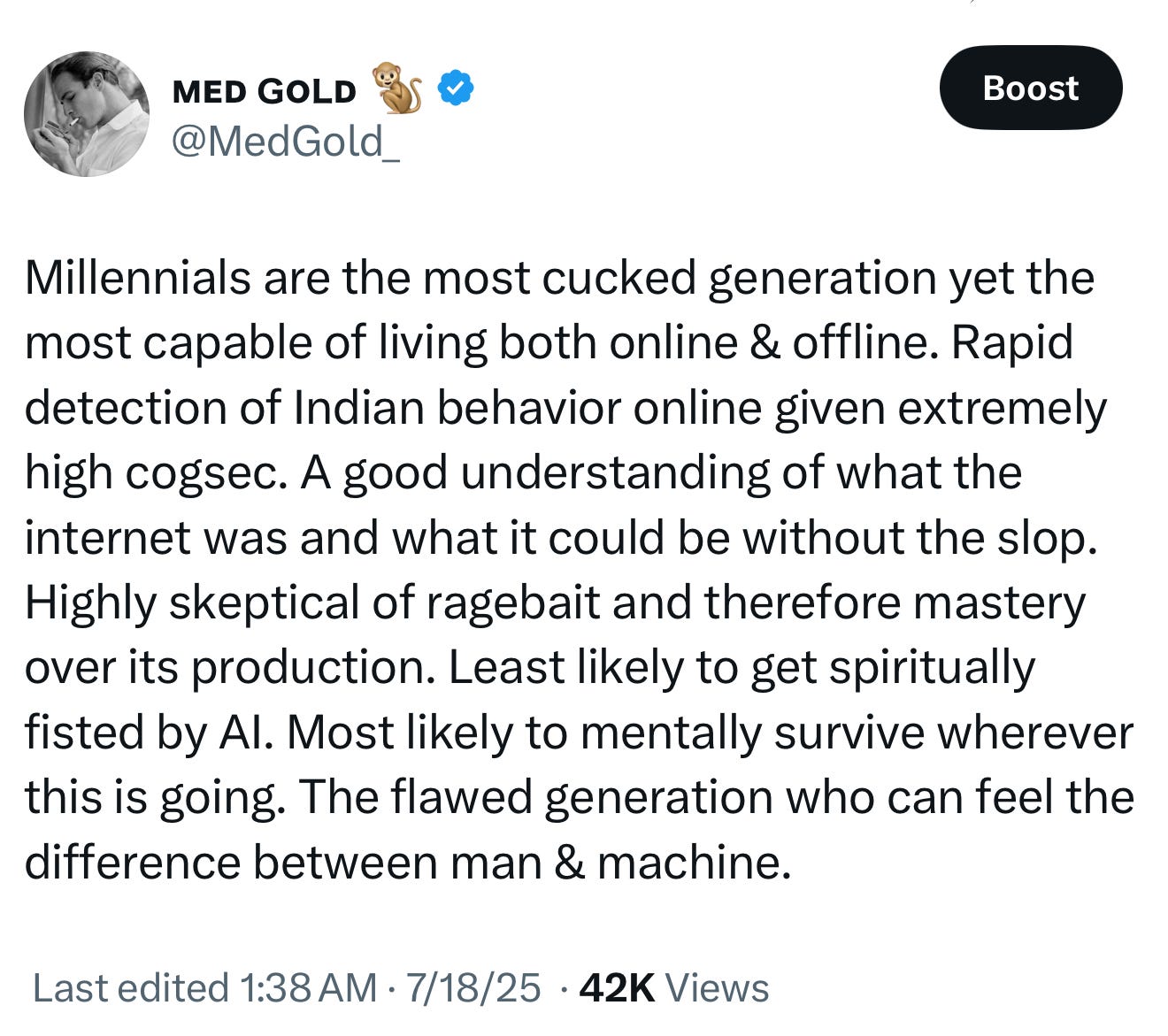
Despite how much I post, friends who know me IRL from my account say I’m one of the least online people they’ve ever met.

I get more engagement in an hour than most people get in a month. I get some of the most vitriol-filled hate on a daily basis that only Donald Trump can relate to. And yet I barely think about it. I post, I respond to replies sometimes, scroll the timeline a bit, then move on with my life. I have a life, so that makes it easier. This is important. I have fun online, but my account is not my life. If it vanishes tomorrow, I’ll be bummed out — but I’ll be fine.
I go to great lengths to not let social media drive me insane, despite how much I may bitch about the avalanche of slop on the timeline lately. Here are some of the barriers I put into place, and how I think about social media in general, to avoid letting it completely take over my life.
Block, Block, Block
If you don’t like an account, block it. Don’t hesitate.
If you don’t want to block them, mute them. Don’t hesitate.
If you don’t like a topic, mute the keyword. Don’t hesitate.
I cannot overstate how important the last point is. I haven’t seen a single video of kid blown up in Gaza since October 7th, 2023. Why? Because I blocked the words: Israel, Gaza, Palestine, Tel-Aviv, Jerusalem, West Bank, Netanyahu, Hamas, etc.
And what changed? Nothing. What could I have done about it? Nothing.
Muting topics is extremely effective. I gain from this because I don’t make myself unnecessarily depressed. I currently have ‘Epstein’ muted. There’s nothing I can do about the Epstein scandal, so I don’t let myself care about it by choosing to avoid the topic.
Most People Online Are Insane
Once you take this very literally, it’s very hard to care about what people online think about you. As I wrote about in The Sanctity of Anonymity, you should not take internet people into consideration because there’s a very high likelihood that you’re getting opinions from someone with a severe mental illness, or someone who’s such a loser IRL that you’d be embarrassed to be seen with them. Given this, I strongly advise against spending too much time in group chats with people. There are people who are actual leeches who do nothing more but spend their entire lives in there and feed off of other people’s energy. It’s extremely embarrassing and terrible for your sanity. Trust me. I had to learn this lesson the hard way. Tread very carefully when it comes to trusting complete strangers online.
Life is Better With Less Social Media
Long-time followers know that I take hiatuses from X a few times a year, sometimes up to 3-6 months. It’s completely random. Sometimes I get a gut feeling that it’s time to log off, so I do. And I’m not exaggerating — once I deactivate and delete the app, it’s as if I never created an account. I forget I even had it. Out of sight, out of mind.
When you’re not being bombarded with usually bad news and bad takes 24/7, your mind is more at ease, and you realize that life isn’t nearly as bad as you’re supposed to think it is. This is a cliche point, but it’s extremely true.
I will probably write about this topic again because there’s more to say. But until then, I strongly recommend putting these principals into practice. Those of us who can resist where AI and social media is going will be rarer than Bitcoin, and will be the very few who people are seen as human, capable of being trusted, and can live a satisfying life.
So much to unpack here! This entire topic of social media and our use of AI fascinates me. The social media part, I was just having a conversation with someone today about it, and I mentioned Neil Postman’s book (it’s old, but still relevant) called “Amusing Ourselves to Death”. I was just saying how in his book, he warned that the shift from print to image-based media, especially television, (and now, by extension, I would say social media), would reduce public discourse to spectacle and emotional manipulation. Serious issues become entertainment, and are stripped of nuance and presented out of context. It’s all performance and content. In the social media landscape, that means we’re conditioned to consume instead of process…and eventually, to feel less and less.
And on the topic of AI, I don’t think the issue is AI itself. As you said, I also think it can be a useful tool. Tool being the key word. The problem is in how we’re using it, and more importantly, what we’re letting it replace. I think the real risk is that it’s making us intellectually lazy. It’s so easy to ask a question and get an answer that sounds so proper and perfectly polished and reasonable, that we stop doing the harder work of sitting with contradictions, asking better questions, or thinking through the implications ourselves.
Also, I once asked ChatGPT how it can speak confidently about moral questions, when its understanding of morality comes from human sources, many of which are biased, contradictory, or completely shaped by time and culture, and it admitted that morality shifts over time. So if that’s the case, what are we really being offered? Something that sounds good? That fits the current moment? That flatters our position? That’s usually what ChatGPT does- it tends to offer you an echo chamber that just validates your own opinions, especially if you present them with a lot of conviction. It doesn’t offer you the friction and the challenge that is usually needed for growth (unless perhaps you specifically ask for it). There is so much more to say here, but I feel like this comment is already long enough…
Great post, Med.
AI as a tool is going to make for a real interesting future where I believe there will be three types of people: first, those who get sucked into it entirely, losing any sense of separation between the digital world and reality. This will, unfortunately, probably be the majority of people. Second, those who avoid it altogether (rare, in all likelihood), and third, those few who hit the sweet spot of understanding how to utilize its potential effectively for enhancing life while setting necessary boundaries. As it becomes more integrated in the world around us, the lines between the three camps will shift but also become more hardened. Its own form of natural selection.
I feel as though the third path has the potential to be the most rewarding by far, but it'll take the most awareness and skill to navigate properly.